How to write a visual basic program. Visual Basic programs for beginners with examples. How to print a string in visual basic. below are some examples of visual basic programs.
In this tutorial, Will see some basic string operation like how to print string and char in visual basic. Check thevisual basic program for mathematical operations.
Let’s start with the basic “Hello World” Project in Visual basic. Start any programming language with some string operation is a really good idea.
Visual C Dialog Based Application - Basic Calculator Application I have come up with basic calculator application using Visual C - Dialog based application. Scroll down to see the download instructions and output. Simple Calculator using Visual basic.NET 11:15 PM Labels: calculator using Visual basic codes, sample application using Visual Basic This is a simple calculator created using VB.Net. For someone that wants to start programming in Visual Basic, I have a simple program that I'm going to show you. I will teach, step-by-step how to build a simple calculator. So here it goes ok? First, make sure you have at least Visual Studio 2005 (it's the best I've ever experimented and you will learn fast).
Write a visual basic program to print a string “Hello World”
The below code will print the string value “Hello World”. Console.WriteLine(” “) is used to print any value as an output and the Console.ReadLine() is used to read the next line here we are using it to hold the screen.
Output: Hello World
Visual basic program to print a string variable.
Declare a variable in visual basic is really simple. here in the below code. Dim str As String is a variable decoration. Where str is a variable of string type.
Output: Write First Program in Visual basic
How to Concat two string in Visual basic.
+ or the & operator is used to Concat two or more string in Visual basic. Below is the code to Concat two string in visual basic. Which contains 3 strings str1, str2,str3.
Output: Visual basic program
Please check more examples on visual basic program for beginner
Visual Basic programs with example
Basic Vb programs
| Example 2.1.1 |
| Example 2.1.2 |
You can also use the + or the & operator to join two or more texts (string) together like in example 2.1.4 (a) and (b)
Calculator Code For Visual Studio
| Example 2.1.4(a) Private Sub A = “Tom” End Sub | Example 2.1.4(b) Private Sub A = “Tom” End Sub |
Write a VB program to convert Celsius to Fahrenheit
Java Program for Interview with example
Past Year’s Placement papers for Interview of MNC
VB.NET GUI
Basic Calculator
In the previous sections, we displayed text in console window (black background window). In this section, you will learn to use window forms and other useful components and controls to create GUI applications that increase interactivity.
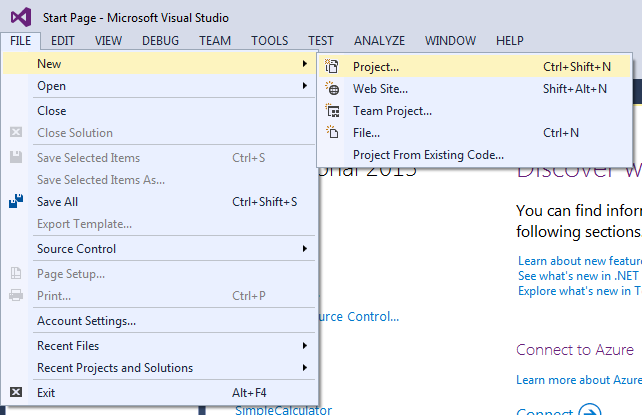
Step1: Create a project (Windows Forms Application)
File->New-> Project...Visual Basic Simple Calculator Code
Step2: Design interface
-Click on Toolbox in the left site to extend it. You will a list of controls as shown in below:
-Drag and drop one textbox and rename it to txtbox(change text in Name field of the properties window to txtbox).
Visual Basic 6.0 Code For Simple Calculator
Note: To open Properties window of a control, right-click the control and click Properties.
-Drag and drop 21 command buttons
-Rename button0 to cmd0, button1 to cmd1, button2 to cmd2, button3 to cmd3, button4 to cmd4, button5 to cmd5, button6 to cmd6, button7 to cmd7, button8 to cmd8, button9 to cmd9, button10 to cmdequal, button11 to cmdclear, button 12 to cmdadd, button13 to cmdsubtract, button14 to cmdmultiply, button15 to cmddivide, button16 to cmdsquare, button17 to cmdsqtr, button 18 to cmdcos, button19 to cmd sin, button20 to cmdtan.
-The caption of each button also needs to be changed. For example, you need to change the caption of button0 to 0, button1 to 1, button 2 to 2...etc.
Step3: Write code
To attach code to a control, you need to double-click the control to open code editor. And then you just copy code and paste it.
'Declaring global variables in General section of the form
Dim sign As String
Dim val1 As Double
Dim val2 As Double
Private Sub cmd0_Click(ByVal sender As System.Object, ByVal e As System.EventArgs) Handles cmd0.Click
txtbox.Text = txtbox.Text & cmd0.Caption 'get 0
End Sub
Private Sub cmd1_Click(ByVal sender As System.Object, ByVal e As System.EventArgs) Handles cmd1.Click
txtbox.Text = txtbox.Text & cmd1.Caption 'get 1
End Sub
Private Sub cmd2_Click(ByVal sender As System.Object, ByVal e As System.EventArgs) Handles cmd2.Click
txtbox.Text = txtbox.Text & cmd2.Caption 'get 2
End Sub
Private Sub cmd3_Click(ByVal sender As System.Object, ByVal e As System.EventArgs) Handles cmd3.Click
txtbox.Text = txtbox.Text & cmd3.Caption 'get 3
End Sub
Private Sub cmd4_Click(ByVal sender As System.Object, ByVal e As System.EventArgs) Handles cmd4.Click
txtbox.Text = txtbox.Text & cmd4.Caption 'get 4
End Sub
Private Sub cmd5_Click(ByVal sender As System.Object, ByVal e As System.EventArgs) Handles cmd5.Click
txtbox.Text = txtbox.Text & cmd5.Caption 'get 5
End Sub
Private Sub cmd6_Click(ByVal sender As System.Object, ByVal e As System.EventArgs) Handle cmd6.Click
txtbox.Text = txtbox.Text & cmd6.Caption 'get 6
End Sub
Private Sub cmd7_Click(ByVal sender As System.Object, ByVal e As System.EventArgs) Handles cmd7.Click
txtbox.Text = txtbox.Text & cmd7.Caption 'get 7
End Sub
Private Sub cmd8_Click(ByVal sender As System.Object, ByVal e As System.EventArgs) Handles cmd8.Click
txtbox.Text = txtbox.Text & cmd8.Caption 'get 8
End Sub
Private Sub cmd9_Click(ByVal sender As System.Object, ByVal e As System.EventArgs) Handles cmd9.Click
txtbox.Text = txtbox.Text & cmd9.Caption 'get 9
End Sub
Private Sub cmdclear_Click(ByVal sender As System.Object, ByVal e As System.EventArgs) Handles cmdclear.Click
'clear Texts
txtbox.Text = '
val1 = 0
val2 = 0
sign = '
End Sub
Private Sub cmdcos_Click(ByVal sender As System.Object, ByVal e As System.EventArgs) Handles cmdcos.Click
Dim v As Double
On Error GoTo aa
v = CDbl(txtbox.Text)
txtbox.Text = Math.Cos(v)
aa: Exit Sub
End Sub
Private Sub cmddivide_Click(ByVal sender As System.Object, ByVal e As System.EventArgs) Handles cmddivide.Click
sign = '/'
On Error GoTo aa
val1 = CDbl(txtbox.Text)
txtbox.Text = '
aa: Exit Sub
End Sub
Private Sub cmdequal_Click(ByVal sender As System.Object, ByVal e As System.EventArgs) Handles cmdequal.Click
On Error GoTo aa
val2 = CDbl(txtbox.Text)
If (sign = '+') Then
txtbox.Text = val1 + val2
ElseIf (sign = '-') Then
txtbox.Text = val1 - val2
ElseIf (sign = '*') Then
txtbox.Text = val1 * val2
Else: txtbox.Text = val1 / val2
End If
aa: Exit Sub
End Sub
Private Sub cmdmultiply_Click(ByVal sender As System.Object, ByVal e As System.EventArgs) Handles cmdmultiply.Click
sign = '*'
On Error GoTo aa
val1 = CDbl(txtbox.Text)
txtbox.Text = '
aa: Exit Sub
End Sub
Private Sub cmdplus_Click(ByVal sender As System.Object, ByVal e As System.EventArgs) Handles cmdplus.Click
sign = '+'
On Error GoTo aa
val1 = CDbl(txtbox.Text)
txtbox.Text = '
aa: Exit Sub
End Sub
Private Sub cmdsin_Click(ByVal sender As System.Object, ByVal e As System.EventArgs) Handles cmdsin.Click
Dim v As Double
On Error GoTo aa
v = CDbl(txtbox.Text)
txtbox.Text = Math.Sin(v)
aa: Exit Sub
End Sub
Private Sub cmdsqare_Click(ByVal sender As System.Object, ByVal e As System.EventArgs) Handles cmdsquare.Click
Dim v As Double
On Error GoTo aa
v = CDbl(txtbox.Text)
txtbox.Text = v ^ 2
aa: Exit Sub
End Sub
Private Sub cmdsqrt_Click(ByVal sender As System.Object, ByVal e As System.EventArgs) Handles cmdsqrt.Click
Dim v As Double
On Error GoTo aa
v = CDbl(txtbox.Text)
txtbox.Text = Math.Sqr(v)
aa: Exit Sub
End Sub
Private Sub cmdsubtract_Click(ByVal sender As System.Object, ByVal e As System.EventArgs) Handles cmdsubtract.Click
sign = '-'
On Error GoTo aa
val1 = CDbl(txtbox.Text)
txtbox.Text = '
aa: Exit Sub
End Sub
Private Sub cmdtan_Click(ByVal sender As System.Object, ByVal e As System.EventArgs) Handles cmdtan.Click
Dim v As Double
On Error GoTo aa
v = CDbl(txtbox.Text)
txtbox.Text = Math.Tan(v)
aa: Exit Sub
End Sub
Private Sub txtbox_KeyPress(ByVal sender As Object, ByVal e As System.Windows.Forms.KeyPressEventArgs) Handles txtbox.KeyPress
Visual Basic Coding Examples
'Allow only number, dot, and backspace characters
If Asc(e.KeyChar) >= Asc('0') And Asc(e.KeyChar) <= Asc('9') Or Asc(e.KeyChar) = 8 Or Asc(e.KeyChar) = 46 Then
Exit Sub
Else
e.KeyChar = '
End If
Visual Basic Code Of Simple Calculator Free
Create Calculator In Visual Basic
End Sub
Comments
Akshay I have one problem, 2015-10-01 |
gowdhami sree this pgm is very useful 2015-08-11 |
david j A tutorial clearly explained showing beginning OO relationships in Forms 2015-01-19 |
nansa thank u soo much.it's really help me 2014-07-31 |
Larry Hello friends.........I have also searched for good tutorial on making calculator. 2014-02-22 |